The First Gold Coin
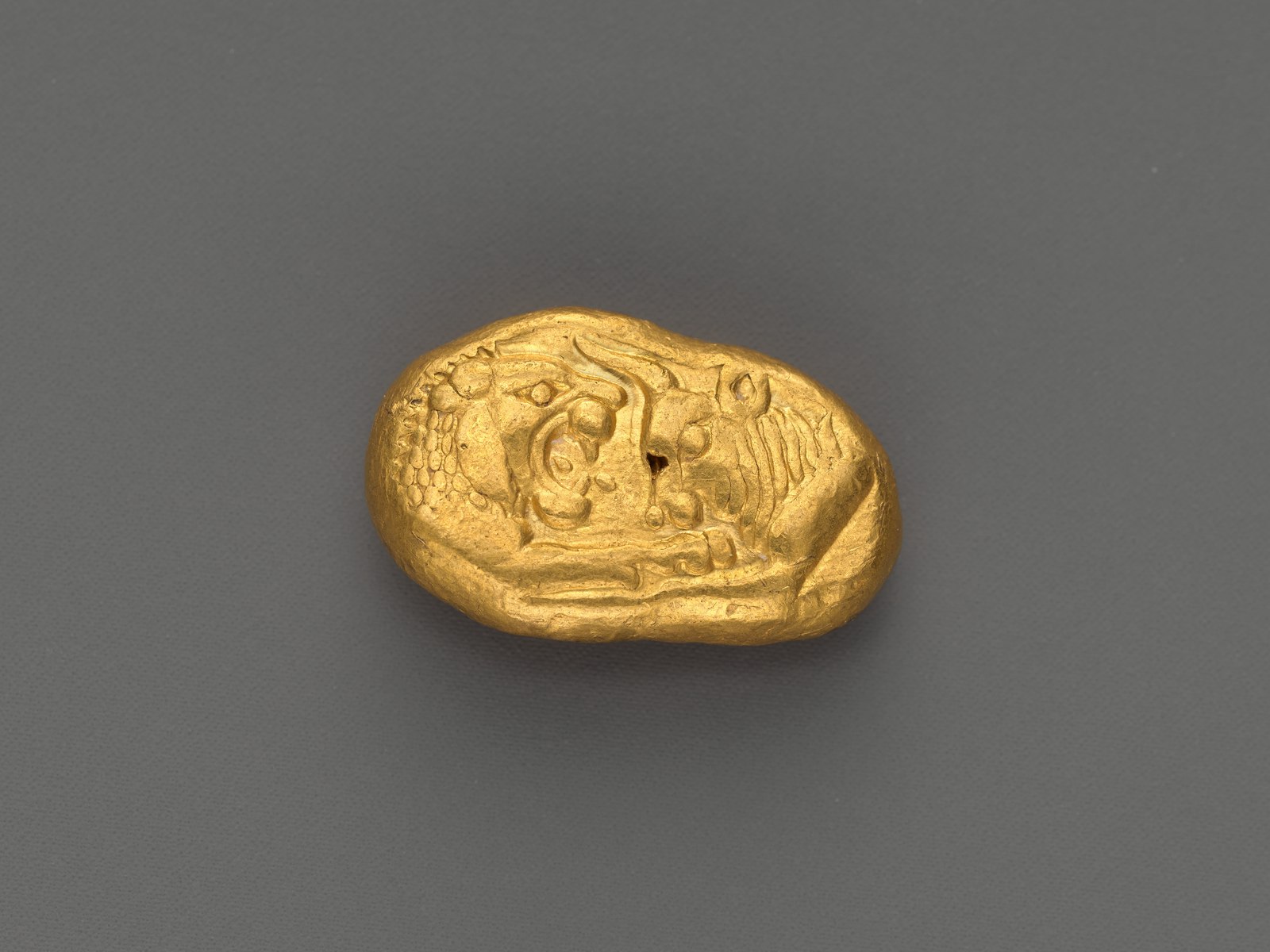
A gold stater of King Croesus — from Lydia, the kingdom that invented the coin
Age
Struck ca. 560–546 B.C. — about 2,570 years old, under Croesus, last king of Lydia
Find it now
The Metropolitan Museum of Art, New York — Greek and Roman Art (Object 26.59.2)
Origin
Sardis, capital of Lydia in western Anatolia (modern Türkiye) — gift of The American Society for the Excavation of Sardis, 1926
It is smaller than your thumbnail: a thick, slightly lopsided lump of pure gold, 1.6 centimetres across and weighing just 8.087 grams. On one side, the foreparts of a lion and a bull stand locked face to face. On the back there is no picture at all — only two rough punched squares, the hammer marks of the mint. This is a gold stater, struck at Sardis, capital of the ancient kingdom of Lydia, in the reign of its last king, Croesus, about 560–546 B.C. Coins of this issue were the first in history struck in pure gold.
Lydia, in what is now western Türkiye, was the place where coinage itself began. Through Sardis ran the River Pactolus, whose sands carried electrum — a natural alloy of gold and silver. For generations, paying for anything meant weighing out lumps and dust of this metal and testing its quality on a touchstone, because no two pieces held the same share of gold. In the late seventh century B.C. the Lydians hit on a simpler idea: stamp small pieces of a fixed weight with an official mark, so that the stamp itself guaranteed the value. Instead of testing the metal, you could simply count. The coin was born.
We know how early this happened because of what was buried at Ephesus. In 1904–5, British Museum archaeologists digging beneath the Temple of Artemis found ninety-three electrum coins that had been deposited as offerings in the late seventh century B.C. Many carried the Lydian royal lion's head, and six were inscribed WALWET — probably the name of King Alyattes, Croesus's father. And they came in astonishingly small change, down to a 1/96 stater of 0.15 grams and four millimetres across, stamped with a lion's paw. From the very beginning, coins were not only for kings and great merchants; a 1/24 stater could buy a sheep or a bushel of grain.
But electrum had a flaw, and the Lydian state quietly exploited it. Laboratory analysis shows that the lion-head coins were debased to about 54 percent gold, yet they were officially valued as if they were natural electrum at about 73 percent gold. A currency that everyone begins to suspect cannot last. Around the middle of the sixth century B.C., Croesus called in the electrum coins and reformed the system completely: refiners at Sardis had mastered the process of parting electrum into its pure metals, and the king now issued coins of pure gold and pure silver side by side — the world's first bimetallic coinage. The gold pieces were known across the Greek world simply as 'Croeseids', after the king. The historian Herodotus wrote that the Lydians were 'the first people we know to have struck and used coinage of silver and gold.'
The proof of the reform still lies in the ground at Sardis. Excavators have found coins of the new coinage beneath the debris of the city wall destroyed when Persia captured Sardis in the mid-540s B.C. — and one small silver coin resting in front of the skull of a young fighter, who had probably been carrying his money in his mouth when he fell. The kingdom vanished, but its invention did not: gold Croeseids travelled across the Aegean as an international currency and were still being kept in the treasuries of Athens a century later. Croesus himself survives in our language every time we call someone 'as rich as Croesus'. And every coin in your pocket descends, in a direct line, from a stamped lump of Lydian gold like this one.
Sources
- The Met — Gold stater, Object 26.59.2
- The Met Open Access API record for Object 252454 (isPublicDomain: true)
- John H. Kroll — "The Coins of Sardis", The Archaeological Exploration of Sardis (Harvard/Cornell)
- Andrew Meadows (British Museum) — "The History of Money: A New Gallery at the British Museum"
Every fact in this exhibit was checked against the sources above. If you spot an error, write to us at [email protected] and we will correct it.